

The Basics: Personal Records
Celebrate your progress with strength and cardio personal records.

Personal Records at a glance
Personal Records, or PRs, highlight your best recorded performances. Whether you’re lifting more weight, completing more reps, or covering a distance faster, they help you see how your training is progressing.
Bevel tracks strength records by exercise and cardio records by sport. Each record captures a different kind of achievement, giving you several ways to recognize progress beyond a single number.
Strength Personal Records
Strength PRs reflect improvements in weight, volume, repetitions, and duration. The records available depend on the exercise, equipment, and workout details you log.
1. Estimated 1 Rep Max
Your highest estimated one-repetition maximum: the weight you could theoretically lift for one rep. Bevel uses an effort-adjusted calculation for harder, lower-rep sets and the Epley formula for lighter-effort or higher-rep sets.
- Example: Completing more reps at the same weight and effort can increase your estimated 1 Rep Max, without performing a maximum-effort single.
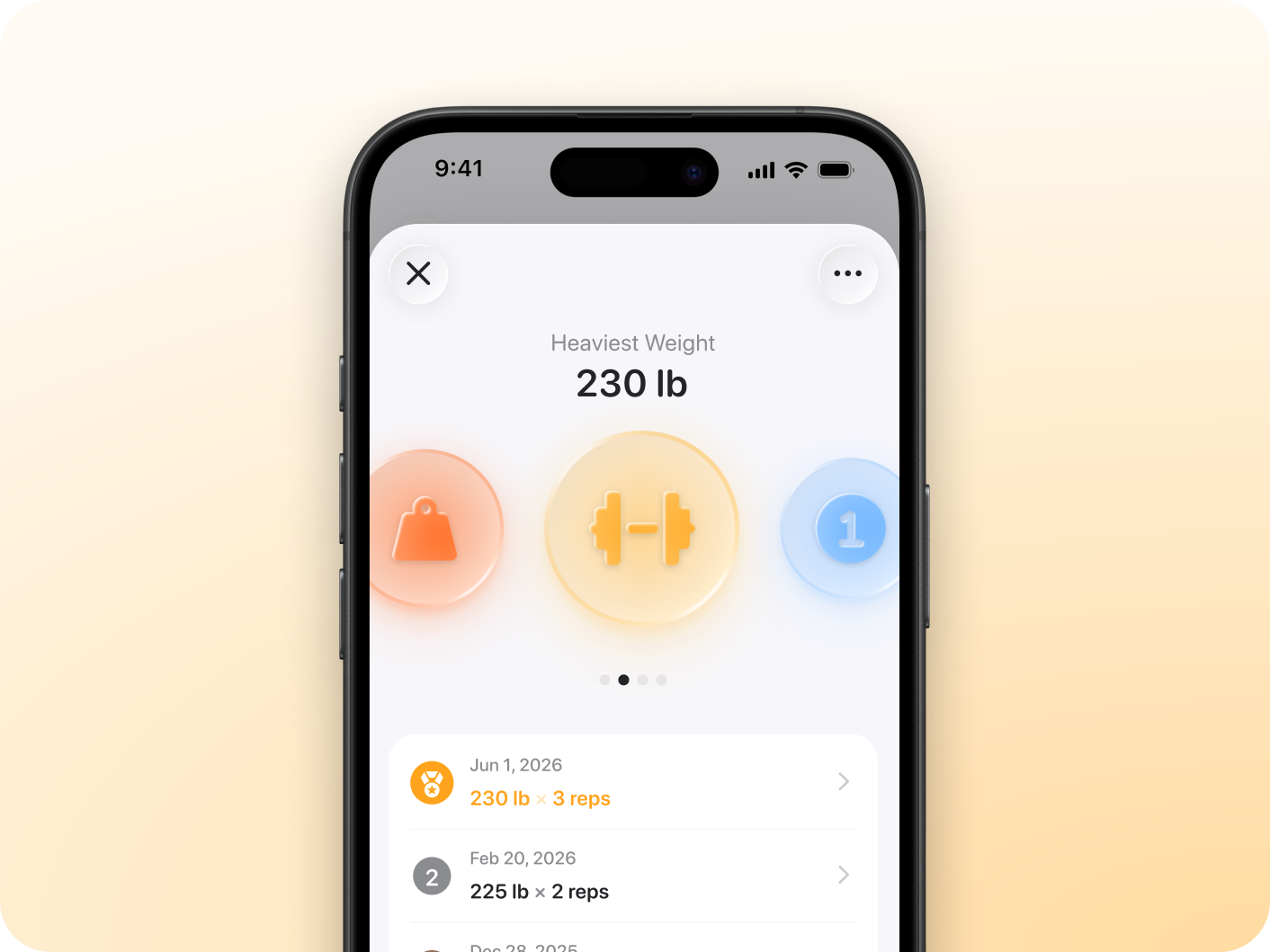
2. Heaviest Weight
The heaviest weight you’ve recorded for an exercise in a single set.
- Example: Increasing your barbell squat from 135 lb to 145 lb can earn a new Heaviest Weight record, even if you perform fewer reps.
3. Session Volume
The highest total volume you’ve completed for an exercise in one workout. Bevel adds up weight × reps across its sets. This record is specific to that exercise, rather than your entire workout.
- Example: Three sets of 10 barbell squats at 115 lb produce 3,450 lb of session volume.
4. Set Volume
The highest volume you’ve completed in a single set, calculated as weight × reps. You can improve this record by increasing the weight, repetitions, or both.
- Example: A set of 12 reps at 115 lb produces 1,380 lb of volume, compared with 1,150 lb for 10 reps at the same weight.
5. Set Reps
The most repetitions you’ve completed in a single set of an exercise. If sets have the same rep count, additional weight helps determine which ranks higher.
- Example: Increasing your best set of push-ups from 15 to 20 reps earns a new Set Reps record.
6. Lowest Assistance
The least assistance you’ve used to complete a set of an assisted exercise.
- Example: Reducing assistance on a pull-up machine from 65 lb to 55 lb represents progress because you’re moving more of your own weight.
7. Longest Time
The longest duration you’ve held or performed an exercise in one set.
- Example: Extending your longest plank from 45 seconds to 60 seconds earns a new Longest Time record.
For weighted bodyweight exercises, weight-based records use the added weight. Assisted exercises track Lowest Assistance instead of weight-based records such as Heaviest Weight or Estimated 1 Rep Max.
Cardio Personal Records
Bevel tracks cardio PRs for running, cycling, pool swimming, and open-water swimming. Indoor and outdoor activities share records within running and cycling, while pool and open-water swimming are tracked separately.
1. Fastest Time
Your shortest recorded time over a supported distance. A record can come from an entire workout or a portion of a longer one. Recorded pauses are excluded from the calculation.
- Example: Your fastest mile may happen during a 5-mile run, even if the full workout isn’t your fastest 5 miles.
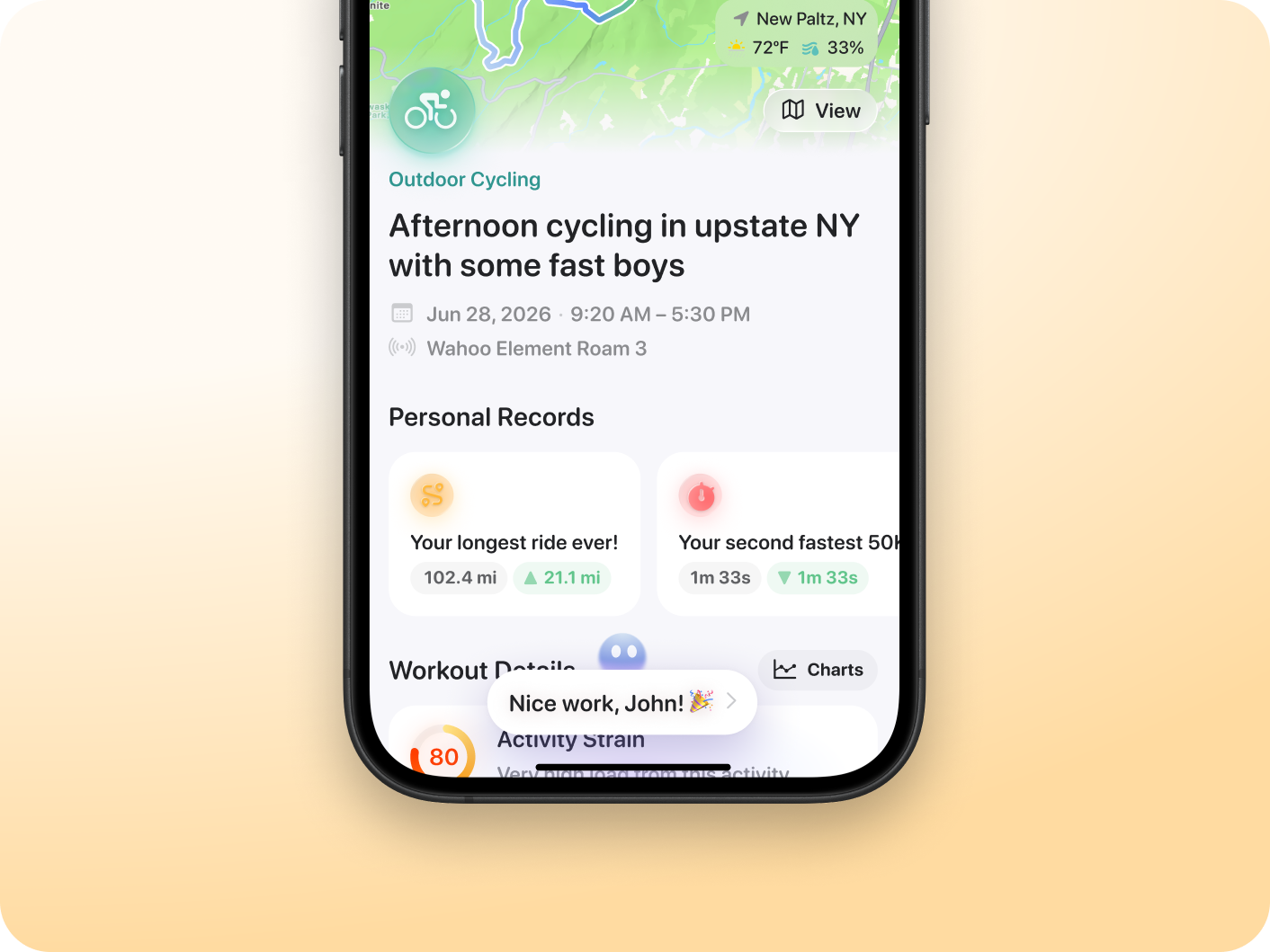
2. Longest Run, Ride, or Swim
The greatest distance you’ve completed in a single workout for that sport.
- Example: Extending your longest run from 5 miles to 6 miles earns a new distance record, regardless of whether you also improve your pace.
3. Most Elevation Gain
The greatest total ascent you’ve recorded in a single cycling workout. This measures climbing accumulated throughout the ride, rather than the highest altitude you reached.
- Example: Several climbs totaling 3,000 feet of ascent beat a previous record of 2,500 feet.
4. Best Power
Your highest average cycling power sustained over 5 seconds, 1 minute, 5 minutes, or 20 minutes. These records require recorded cycling power data.
- Example: Sustaining an average of 220 watts for 20 minutes beats a previous 20-minute record of 210 watts.
Where to find your Personal Records
You can view your PRs in two places:
- Exercise and activity charts: Add a chart for a strength exercise or cardio activity, such as Cycling Total Distance. Your related Personal Records will be listed at the bottom.
- Activity details: After completing a workout, open its activity details to see any Personal Records you achieved during that session.
How to use Personal Records effectively
Keep your records accurate. Log strength exercises, weights, reps, and durations consistently. Cardio records depend on the distance, timing, elevation, and power data available.
Recognize different kinds of progress. More reps, less assistance, or a longer distance can be meaningful achievements alongside heavier lifts and faster times.
Let records follow your training. Every session doesn’t need a personal best. Use PRs to celebrate milestones while keeping your goals, recovery, and consistency in view.


